The inside-out technique for central venous occlusion: who it is for and what it can achieve
After my #FromTheOR post and my talk in Dortmund, several colleagues asked me whether the inside-out technique could be an option for their patients. So here is a short overview: how the technique works, who it is suitable for, and where its limits are.
The problem: burned bridges
Every central venous catheter, every port and every pacemaker can leave its mark on the central veins. In dialysis patients who have received catheter after catheter over many years, this leads to stenoses and occlusions of the brachiocephalic vein or the superior vena cava.
Once the peripheral options for an AV access are exhausted as well, things become difficult. A new catheter often cannot be advanced through the occluded veins, and recanalisation does not always succeed.
What then often remains are alternative routes, for example femoral, transhepatic or translumbar. These, however, come with their own technical problems, infection risks and potential complications.
The principle: from below
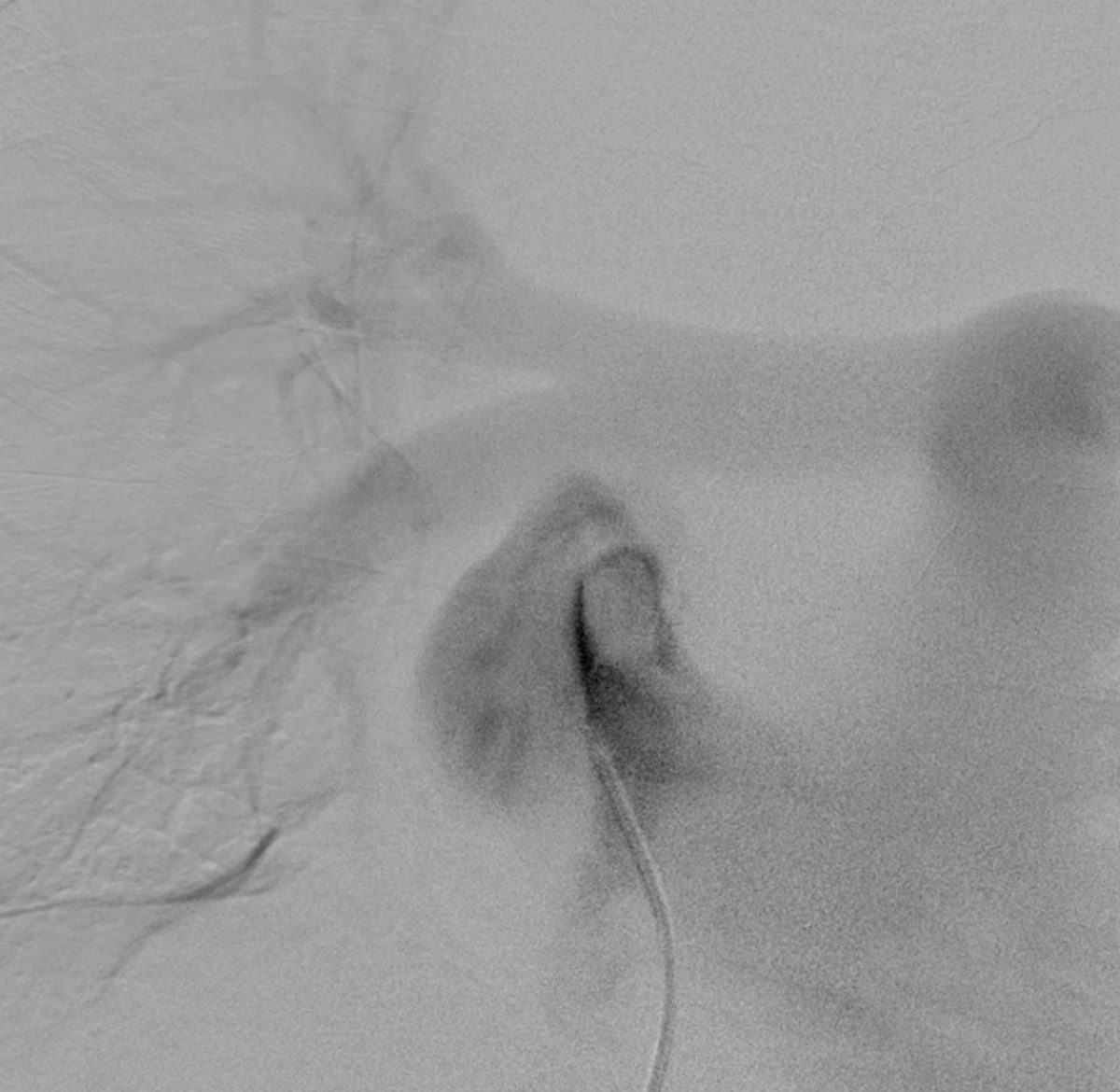
The inside-out technique reverses the direction. Instead of fighting the occlusion from above, you approach it from below. The route is right-sided:
1. Access via the right femoral vein. A dedicated catheter system is advanced through the right iliac vein, the inferior vena cava and the right atrium up to the occlusion of the superior vena cava or the right brachiocephalic vein.
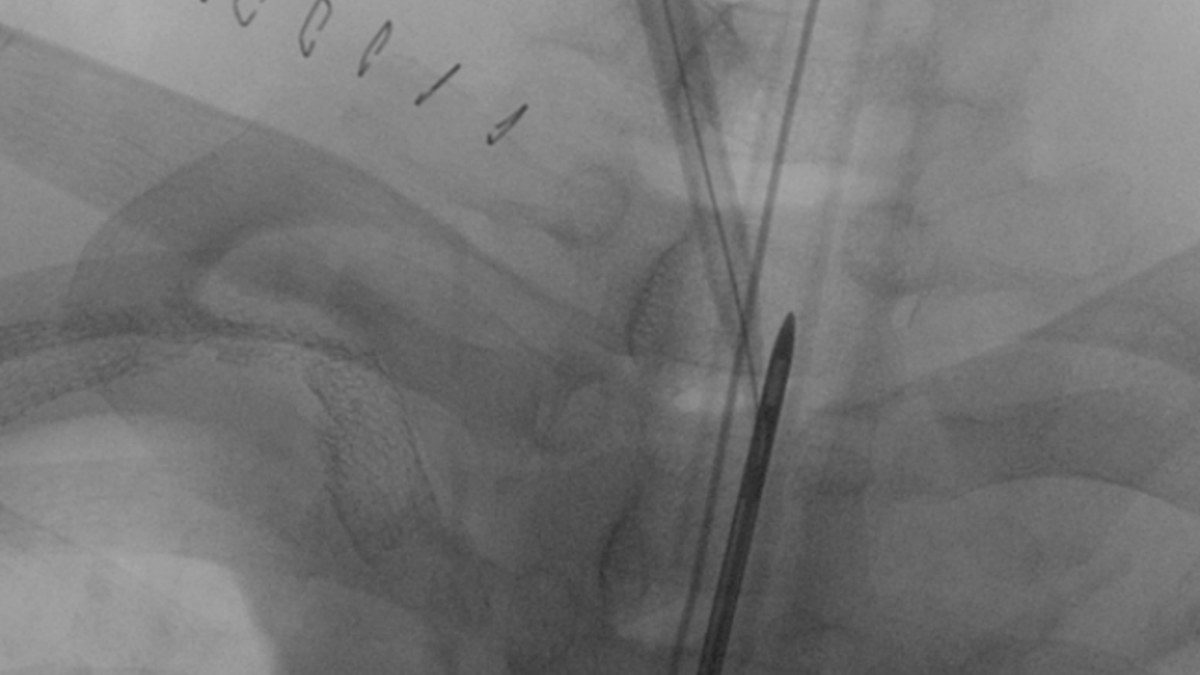
2. Crossing from the inside. A needle wire crosses the occlusion and exits through the skin in the right supraclavicular region. This creates a new route that allows catheter placement on the right side of the neck.
3. Catheter placement from above. Through this newly created route, a tunnelled dialysis catheter is inserted and its tip positioned in the right atrium.
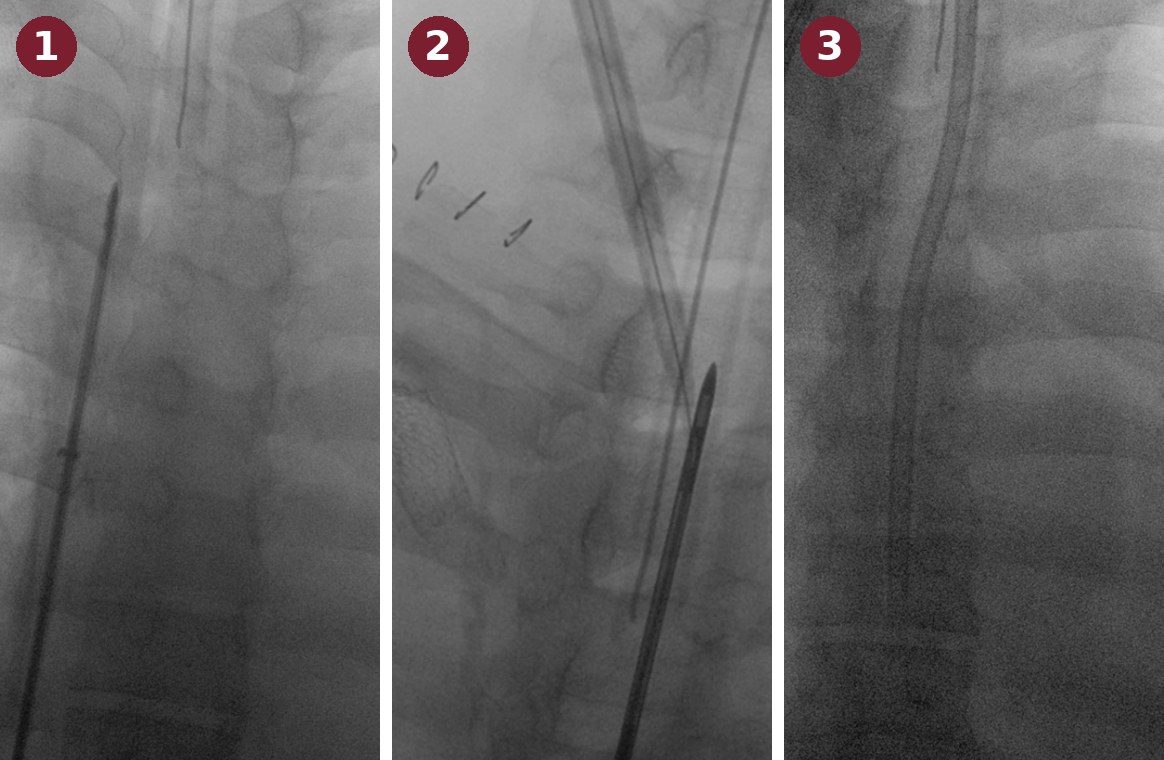
The procedure is performed under fluoroscopy. Ideally, the patient leaves the OR with a functioning right-sided supraclavicular catheter access.
The new route does not have to serve a catheter only, however. In combination with a HeRO Graft, it can also be used to place the venous outflow component. This makes it possible to create an arteriovenous dialysis access again, with outflow directly into the right atrium.
Who is it for?
Typical candidates are patients
- who need central venous access for dialysis,
- whose right-sided central veins are occluded, often after numerous previous catheter placements,
- and in whom conventional access routes or attempts at recanalisation have failed or appear unlikely to succeed.
The prerequisite is an open route from below: the right femoral vein, the right iliac vein, the inferior vena cava and the right atrium must be accessible.
The target is the right side of the neck. The system is not intended for creating a left-sided inside-out access.
Marked venous tortuosity or unusual anatomy can also make the procedure impossible.
Complete occlusions of the superior vena cava reaching right down to the right atrium are particularly critical. Here, imaging must clarify whether a safe intravascular starting point for the inside-out technique exists. Not every complete occlusion is suitable for the procedure.
Careful imaging, for example CT venography or conventional venography, therefore always comes before the decision.
Also important: if a functioning autologous fistula can still be created, this option should be considered first.
At the same time, the inside-out technique is not reserved for patients whose fistula options are completely exhausted. If, for example, an AV fistula is still possible on the left side, but the patient temporarily needs a tunnelled dialysis catheter and the right-sided central veins are occluded, the inside-out technique can be particularly useful.
Instead of placing a left-sided dialysis catheter, which could compromise the venous outflow of a future fistula, this approach creates a right-sided catheter access and preserves the left side for the planned fistula.
What the data show
The technique is not new. We have been using it in Cologne since 2016 and were involved in the first clinical evaluations.
First multicentre case series (2020): A retrospective study from Vienna, Oxford and Cologne assessed 36 patients with central venous occlusion. The technique was applicable in 32 patients. Catheter placement succeeded in 38 of 39 procedures (97%). No procedure-related complications were observed. The median procedure time was 43 minutes.¹
European SAVE registry (2020): At five European centres, catheter placement succeeded in 29 of 30 patients (96.7%). No device-related complications were observed.²
SAVE-US study (2021): A prospective US multicentre study of 30 patients achieved a technical success rate of 90%. The unsuccessful procedures were mainly associated with marked venous tortuosity.³
An important advantage: the technique can be repeated
One aspect is particularly relevant for clinical practice in my view: an inside-out procedure does not have to be a one-time solution.
Our first publication already showed that the technique can be applied repeatedly. In seven patients, a new inside-out access was created more than three months after the first.¹
Our long-standing experience in Cologne also shows that a repeat procedure can be possible after months or even years, provided the anatomical conditions are still met.
For patients whose access options are largely exhausted, this is of considerable practical importance.
Conclusion
"Burned bridges" do not always mean the end of the road.
For selected patients with central venous occlusion, the inside-out technique can provide dialysis access where conventional approaches no longer succeed.
What matters is careful patient selection, precise assessment of the central venous anatomy, and collaboration between nephrology, interventional radiology and vascular surgery.
If you are caring for a patient for whom this option might be relevant, feel free to contact me via the contact form or on LinkedIn.
If you would like to try the technique yourself on a model: it is part of the hands-on programme at the workshop on 16 December 2026 at the 11th Cologne Dialysis Access Symposium.
References
1. Reindl-Schwaighofer R, Matoussevitch V, Winnicki W, Kalmykov E, Gilbert J, Matzek W, Sengoelge G. A novel inside-out access approach for hemodialysis catheter placement in patients with thoracic central venous occlusion. Am J Kidney Dis. 2020;75(4):480–488. doi:10.1053/j.ajkd.2019.08.024
2. Gallieni M, Matoussevitch V, Steinke T, Ebner A, Brunkwall S, Cariati M, Gallo S, Reindl-Schwaighofer R, Sengoelge G. Multicenter experience with the Surfacer Inside-Out Access Catheter System in patients with thoracic venous obstruction: results from the SAVE Registry. J Vasc Interv Radiol. 2020;31(10):1654–1660. doi:10.1016/j.jvir.2020.06.020
3. Razavi MK, Peden EK, Sorial E, Ross JR, Aruny JE, Pflederer TA, Wasse H, Haskal ZJ. Efficacy and safety associated with the use of the Surfacer® Inside-Out® Access Catheter System: results from a prospective, multicenter FDA-approved Investigational Device Exemption study. J Vasc Access. 2021;22(1):141–146. doi:10.1177/1129729820937121
Dr. Vladimir Matoussevitch | VascularAccessTalk
Transparency: Merit Medical, manufacturer of the Surfacer system, supports the Cologne Dialysis Access Symposium.